Skip Navigation Freightliner Sprinter Vans
    • Manuals
    • Parts & Services
    • Warranty & Maintenance
    • Recall
    • BlueTec Update
    • Lifestyle Accessories
    • Roadside Assistance
    • Collision & Repair
    • Genuine Parts
  • Find a service location
    • Manuals
    • Parts & Services
    • Warranty & Maintenance
    • Recall
    • BlueTec Update
    • Lifestyle Accessories
    • Roadside Assistance
    • Collision & Repair
    • Genuine Parts
    • Find a service location

A variety of Frieghtliner vans outside a loading dock.

Your dream van
is now your next van.

It’s real. Your business could save up to $26,200 in section 179 deductions – that’s up to $5,502 in savings. [1]

Section 179 Tax Savings

Section 179 of the I.R.S. tax code offers significant deductions on qualifying business vehicles.

A Mercedes-Benz Sprinter Van and a Mercedes-Benz Metris van in a parking lot.

What business vehicles may qualify?

You may qualify if you:

  • Are a business that purchased or financed qualifying new or used business equipment, including certain business-use vehicles, during the 2021 tax year.

  • Put the equipment into service between January 1, 2021, and December 31, 2021.

  • Used this equipment for business purposes more than 50% of the time.

  • Spent less than $3,670,000 on this equipment.

A catering business owner unloading his Mercedes-Benz Sprinter Van.

How much could I deduct?

These are the limits:

  • You cannot write off more than $1,050,000.

  • The total amount of the equipment purchase cannot be more than $2,620,000. It phases out dollar-for-dollar after that, so once $3,670,000 is spent, the deduction goes away entirely.

A Mercedes-Benz Metris van with text that says “Get up to $26,200 in Section 179 tax deductions.”

Section 179 highlights

  • Section 179 allows qualifying businesses to deduct up to the full purchase price of certain new or used vehicles, equipment and/or software purchased and placed into service during the tax year.

  • To qualify, the percentage of business use for the vehicle, equipment or software must be more than 50%.

Choose the van that’s right for your business.

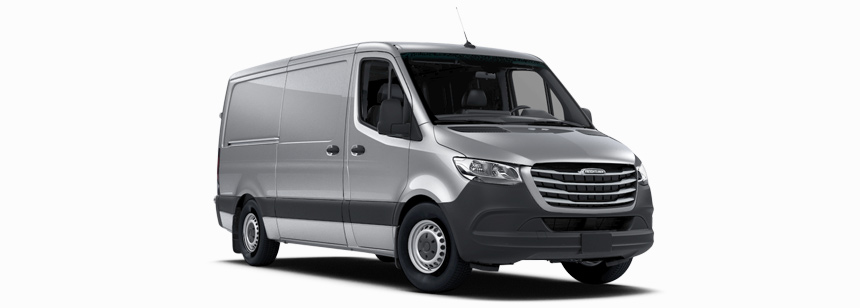
Sprinter Cargo Van

View of a Freightliner Sprinter Cargo Van.

Starting at $36,355*

See Details

Sprinter Passenger Van

View of a Freightliner Sprinter Passenger Van.

Starting at $43,120*

See Details

Additional Resources

Total Cost of Operation

View of a Mercedes-Benz van’s odometer showing total cost per mile of 64¢.

Section 179 can help make a Freightliner van a great deal now. Freightliner makes it a great deal for the years to come. [2]

See the Numbers

Build Your Van

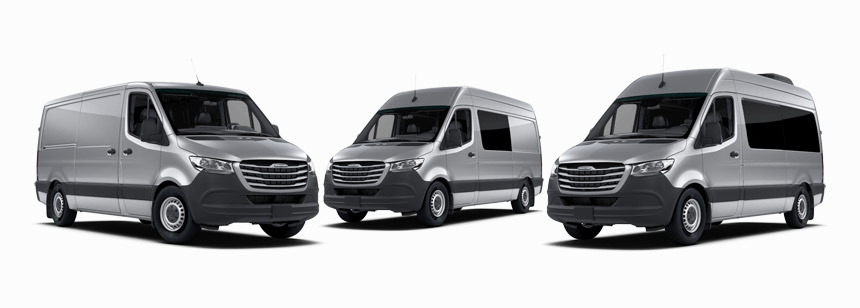
View of three different Freightliner vans.

A great choice for tax savings, configurable for your business’ needs.

Get Started

  • Manuals
  • Parts & Services
  • Recall
  • Bluetec Update
  • Lifestyle Accessories

  • Daimler | Freightliner - A Daimler Group Brand
  • Freightliner | Freightliner Trucks
  • ©2026 Daimler Vans USA, LLC
    • Do Not Sell My Personal Information
*

Base MSRP excludes transportation and handling charges, destination charges, taxes, title, registration, preparation and documentary fees, tags, labor and installation charges, insurance, and optional equipment, products, packages and accessories. Actual vehicle price may vary by Dealer. Optional and European model shown. Optional equipment availability may vary.

†

Starting at prices represent gas engine models. Excludes all options, taxes, title, registration, transportation charge and dealer prep fee. Options shown. Not all options are available in the U.S. For a full offering and pricing information, visit your local Freightliner Sprinter dealership. Delayed availability.

NA

Models shown may include options/packages not standard on a MY21 Sprinter. Specifications are subject to change.

1

$5,502 tax savings based on 21% federal corporate tax rate and eligibility to claim full $26,200 IRS Section 179 tax deduction for qualified vehicles. Your tax rate and eligibility may vary. Please consult a tax professional for more information on your federal tax rate and potential tax savings available to you for qualifying purchases. This information does not constitute, nor is it intended to be, legal, tax, financial planning or investment advice and should not be relied upon as such.

$26,200 tax deduction for qualifying vehicles based on current Section 179 of U.S. tax code and maximum deduction permitted for such vehicles under Section 179. Vehicle must be purchased for business use. Please consult your tax professional for more information on applicability of deduction and whether you qualify for the maximum amount available.

Offer valid through December 31, 2021.

2

Vincentric™ is an independent research organization that provides data, knowledge, and insight to the automotive industry by identifying and applying the many aspects of automotive operation costs. Vincentric results displayed are based on total cost-of-operation calculations in the retail market using its most recent monthly update.

TCO per mile may vary based on vehicle model, location, road and weather conditions.

VINCENTRIC COST FACTORS DESCRIPTION

Market Price: The Vincentric market price is determined using a proprietary algorithm that accounts for recent sales trends, day’s supply of inventory, destination charges, and actual sales transactions.

Finance: The amount it costs to borrow money for a vehicle purchase. A 60-month loan term with 15% down payment is assumed.

Insurance: Vincentric insurance cost estimates vary by vehicle type and assume over 6 years of driving experience. A standard insurance coverage is used based on data from multiple sources, with costs varying by state.

Fuel: Fuel costs are calculated by taking into account fuel price, inflation, annual mileage, as well as city and highway MPG and will vary by state. A default driving of 55% city and 45% highway is assumed.

Maintenance: Maintenance costs are affected by four key elements: Frequency, Labor Times, Labor Rates, and Parts pricing and are specific to the vehicle. Only scheduled maintenance items are included in the maintenance cost which includes all manufacturer recommended services such as oil changes, air filters, and vehicle inspections. Because labor rates vary by state, maintenance costs will also vary by state.

Repairs: The estimated cost owners will pay to keep their vehicle in operating condition. This value does not include maintenance cost, but instead estimates unexpected product and service costs. This estimate takes into account any bumper to bumper warranty offered by the manufacturer.

State Fees & Taxes: Administrative fees such as registration and titling fees add to the cost of owning a vehicle and will vary by state. In addition, state sales tax is included as are any reduction in taxes as a result of national tax credits available for electric vehicles.

Depreciation: The reduction in value a vehicle incurs during a given period of time.

Opportunity: The loss of potential interest earnings, had the out-of-pocket expenses incurred by owning and operating this vehicle been invested in a savings account.